
How to Fix Uneven Jawline: 7 Methods That Actually Work
 How to Fix Uneven Jawline
You're looking in the mirror, and something feels off. One side of your jaw looks stronger, sharper — while the other side seems softer or smaller. You tilt your head. Take a selfie. Flip the image. Now it looks even worse.
If you've been Googling "how to fix uneven jawline" at 2 AM, you're not alone. Jaw asymmetry is one of the most common facial concerns, and it's also one of the most misunderstood.
Here's what most articles won't tell you: the majority of uneven jawlines aren't caused by bone structure — they're caused by muscle imbalances and habits. And those can be changed.
In this guide, I'll walk you through exactly why your jawline looks uneven, 7 proven ways to fix it (from specific exercises to professional treatments), and how to figure out which approach is right for your situation.
Not sure how uneven your jawline actually is? Take a Face Symmetry Test to get an objective measurement before you start — you might be surprised by what you find.
Why Is My Jawline Uneven? 5 Root Causes
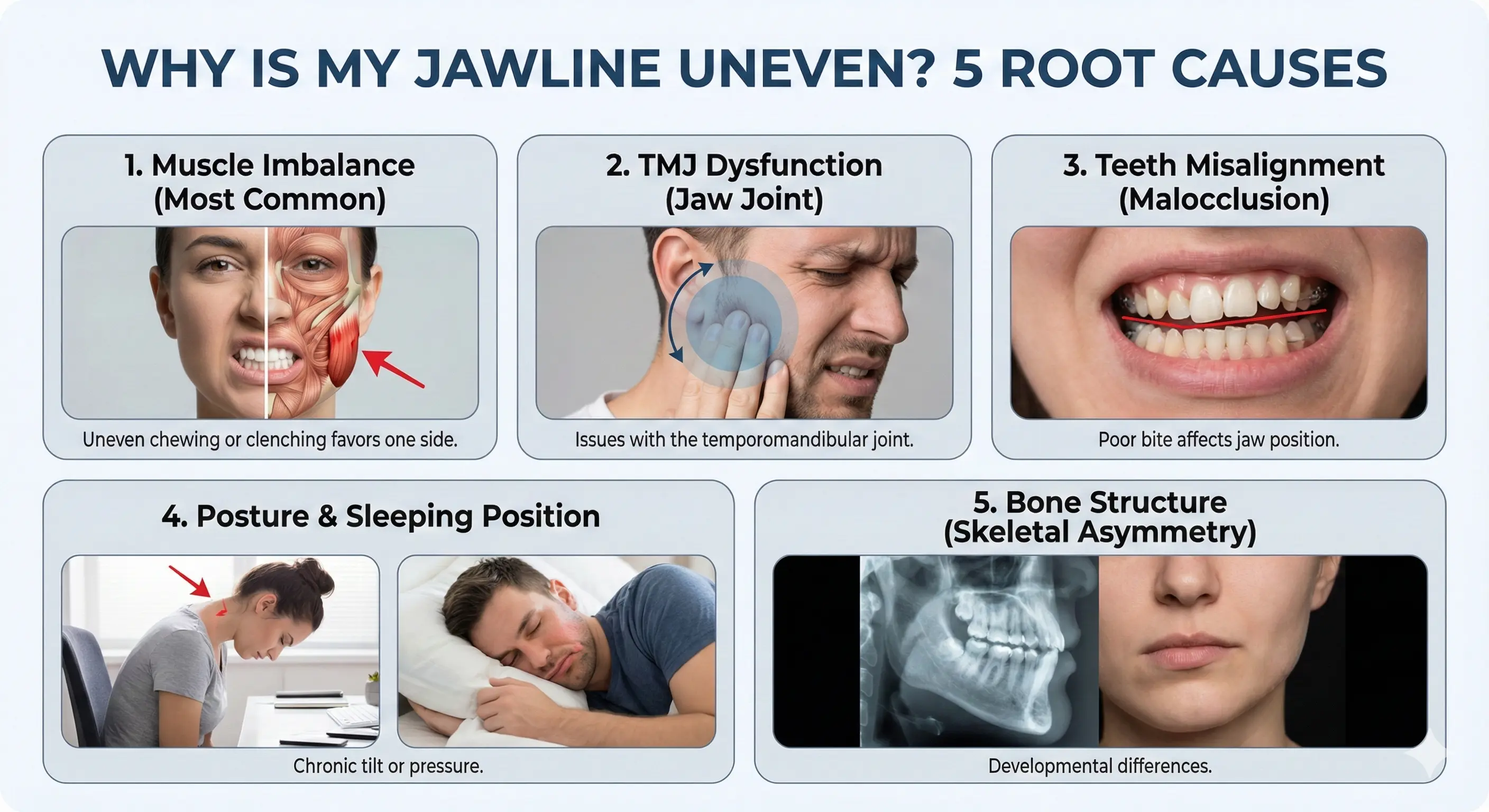 Why Is My Jawline Uneven? 5 Root Causes
Before jumping into solutions, you need to understand what's causing your uneven jawline. Different causes need different fixes.
Why Is My Jawline Uneven? 5 Root Causes
Before jumping into solutions, you need to understand what's causing your uneven jawline. Different causes need different fixes.
1. Muscle Imbalance (The Most Common Cause)
Your jaw has two key muscle groups that control its movement:
- Masseter muscle — the powerful chewing muscle at the angle of your jaw
- Lateral pterygoid muscle — controls forward and side-to-side jaw movement
When you consistently use one side more than the other, these muscles develop unevenly. The overworked side gets bigger and tighter, while the underused side stays smaller.
Signs this is your issue:
- One side of your lower jaw looks wider or more "square"
- When you clench your teeth, one side feels harder or bulges more
- You unconsciously chew food on one side
This is actually good news — muscle imbalances are the most fixable type of jaw asymmetry.
If your face also looks fuller on one side (not just the jaw), check out our guide on why one side of your face looks fatter for targeted solutions.
2. TMJ Dysfunction (Jaw Joint Problems)
Your temporomandibular joint (TMJ) is the hinge connecting your jaw to your skull. When this joint has problems, it can cause your jaw to sit unevenly or deviate to one side.
Common TMJ symptoms:
- Clicking, popping, or grinding when you open your mouth
- Jaw pain, especially in the morning
- Headaches, earaches, or even shoulder pain
- Jaw "locking" or feeling stiff
- Ringing in the ears (tinnitus)
Important: If you have TMJ symptoms, exercises alone won't fix the underlying problem. You'll need professional evaluation first.
3. Teeth Misalignment (Malocclusion)
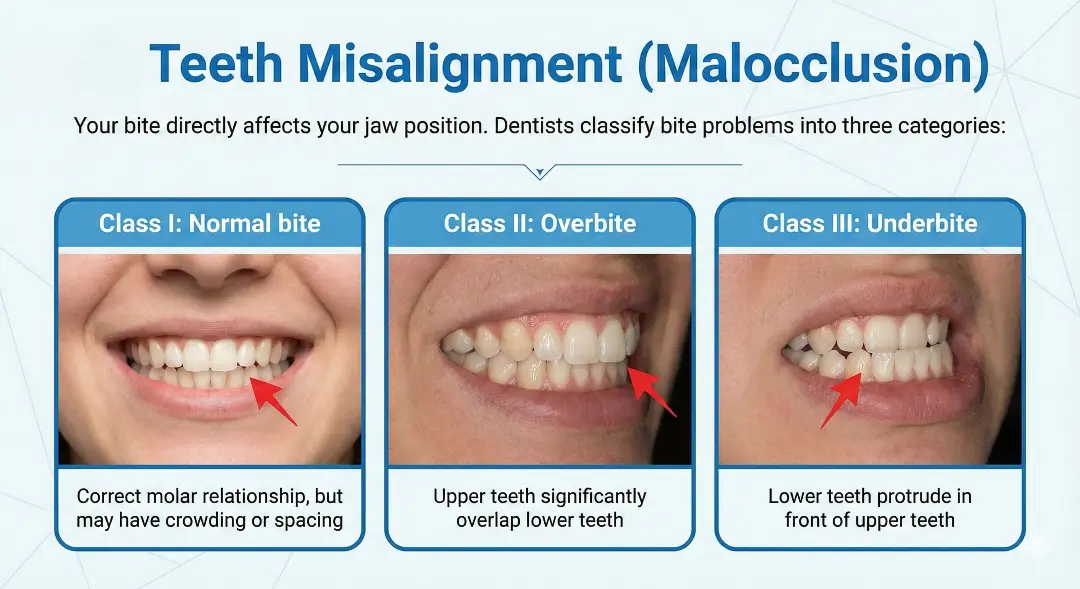 Teeth Misalignment (Malocclusion)
Your bite directly affects your jaw position. Dentists classify bite problems into three categories:
Teeth Misalignment (Malocclusion)
Your bite directly affects your jaw position. Dentists classify bite problems into three categories:
| Class | Type | Description |
|---|---|---|
| Class I | Normal bite | Correct molar relationship, but may have crowding or spacing |
| Class II | Overbite | Upper teeth significantly overlap lower teeth |
| Class III | Underbite | Lower teeth protrude in front of upper teeth |
Any of these can cause your jaw to compensate by shifting position, creating visible asymmetry.
Signs this is your issue:
- Your bite feels uneven when you close your mouth
- You've had dental work on one side but not the other
- Missing teeth or significant dental issues
- An orthodontist has mentioned bite problems before
4. Posture and Sleeping Position
Poor posture doesn't just cause back pain — research suggests it can increase jaw-related pain risk by up to 400%.
How it affects your jaw:
- Forward head posture shifts your jaw position
- Consistently sleeping on one side compresses facial tissues
- Leaning your chin on your hand pushes your jaw off-center
Signs this is your issue:
- You spend long hours looking down at screens
- You've slept on the same side for years
- You often rest your chin on your hand
5. Bone Structure (Skeletal Asymmetry)
Sometimes, the jaw bones themselves developed unevenly. This includes conditions like:
- Hemifacial microsomia — a congenital condition affecting one side of the face
- Growth differences during development
- Previous trauma or fractures
Signs this is your issue:
- Your asymmetry has been present since childhood
- The difference is visible even when your muscles are completely relaxed
- A dentist or doctor has mentioned bone asymmetry
Reality check: Even with skeletal asymmetry, muscle imbalances are often layered on top. Addressing the muscle component can still make a visible difference.
How to Fix Uneven Jawline: 7 Proven Methods
Now for the solutions. These are organized from free at-home methods to professional treatments, so you can start with the least invasive approach.
Tier 1: At-Home Exercises and Habit Changes
These work best for mild to moderate asymmetry caused by muscle imbalance or habits.
1. Jaw Symmetry Exercises (Daily Routine)
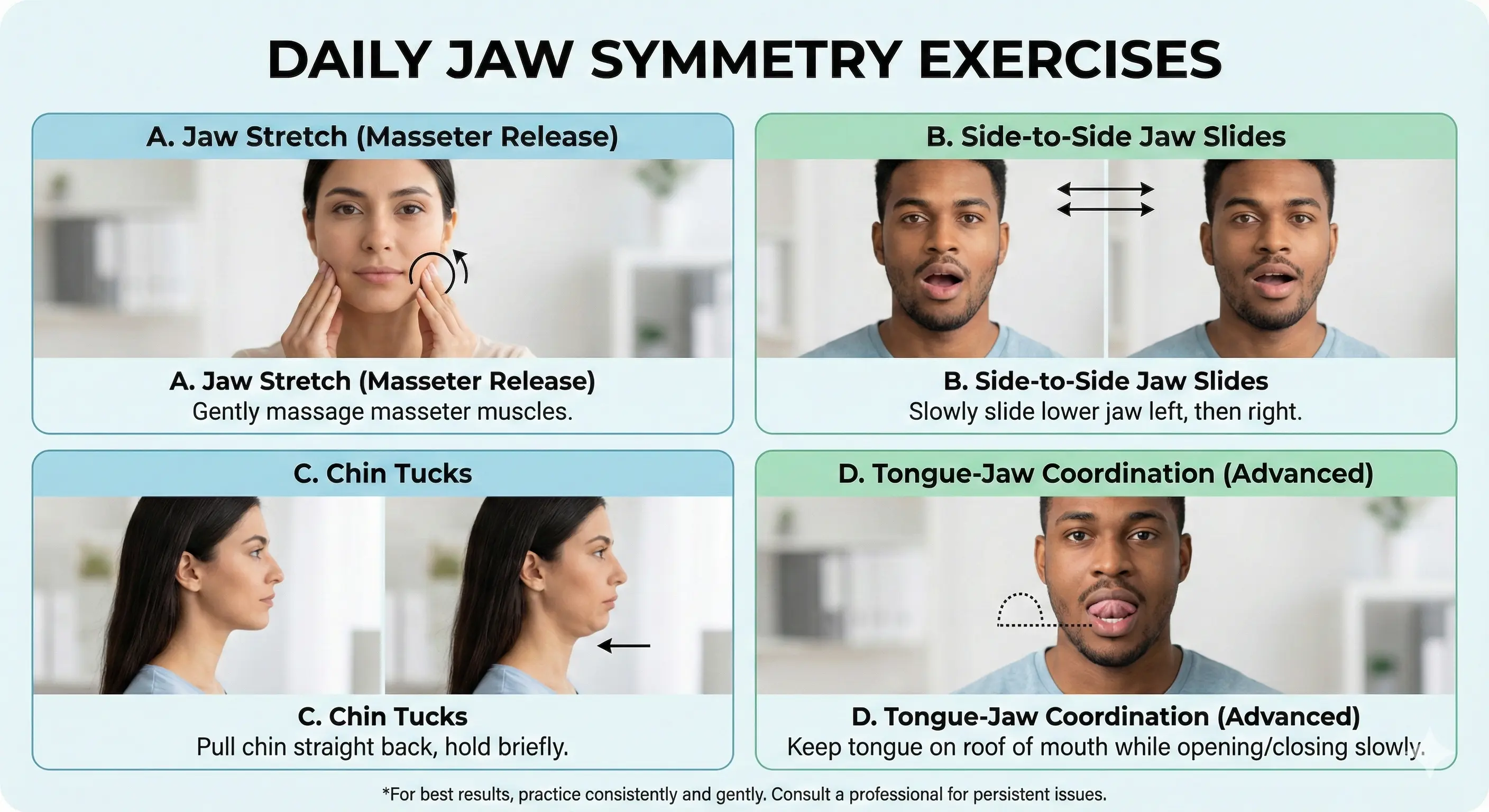 Daily Jaw Symmetry Exercises
Your jaw muscles need to work together as a team. These exercises help balance both sides.
Exercise A: Jaw Stretch (Masseter Release)
This targets the masseter muscle to release tension on the tighter side.
- Sit comfortably with shoulders relaxed
- Apply gentle pressure to your masseter muscles (the area at the angle of your jaw) with your fingernails
- Slowly open your mouth as wide as comfortable — imagine yawning
- Hold for 5 seconds
- Close slowly and completely
- Repeat 10 times
Do this before the other exercises to prepare your muscles.
Exercise B: Side-to-Side Jaw Slides
This works the lateral pterygoid muscle and teaches your jaw to move evenly.
- Start with lips closed, face relaxed
- Slide your lower jaw to the LEFT as far as comfortable
- Hold for 5 seconds
- Return to center
- Slide to the RIGHT, hold 5 seconds
- Repeat 10 times each side
Focus on controlled, smooth movement — not force.
Exercise C: Chin Tucks
This corrects head posture, which directly affects jaw alignment.
- Sit up straight, look straight ahead
- Pull your chin straight BACK (like making a double chin)
- Don't drop your chin down — move it backward toward your spine
- Hold for 5 seconds
- Return to neutral
- Repeat 10-15 times
Exercise D: Tongue-Jaw Coordination (Advanced)
This technique helps correct jaw deviation by coordinating tongue and jaw movement.
- Identify which side your jaw deviates toward
- Push your tongue firmly against the OPPOSITE cheek
- While holding tongue pressure, slowly open your mouth
- Keep your jaw moving in a straight line (use a mirror)
- Hold open position for 3 seconds
- Repeat 5-10 times
Daily routine: Do exercises A through D once in the morning and once before bed. Total time: ~5 minutes.
Timeline: Expect initial changes in 6-8 weeks with consistent practice.
2. Balance Your Chewing Habits
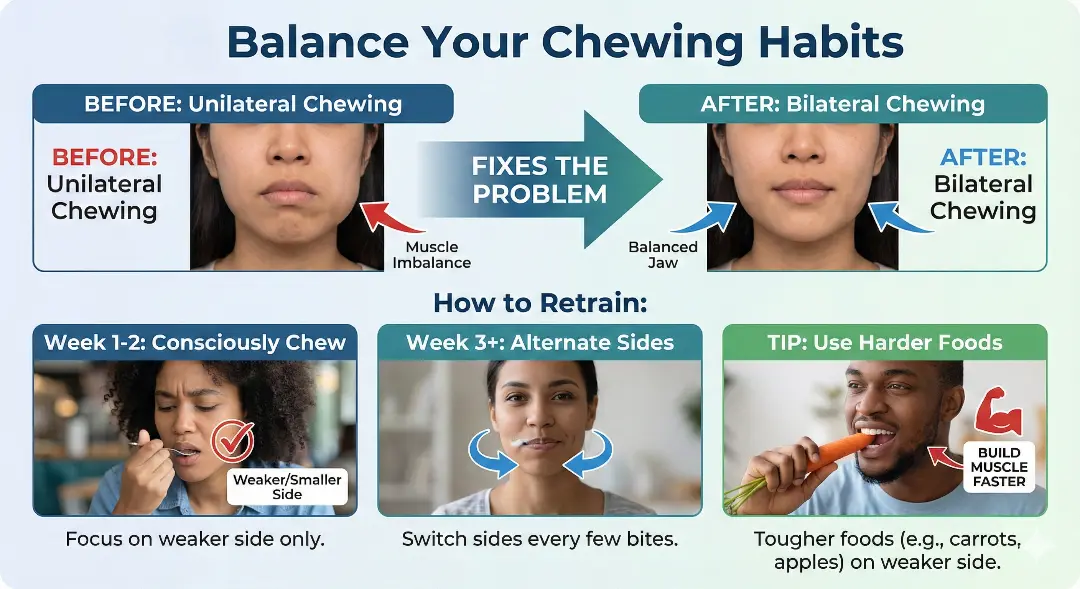 Balance Your Chewing Habits
If unilateral chewing caused your problem, bilateral chewing can help fix it.
Balance Your Chewing Habits
If unilateral chewing caused your problem, bilateral chewing can help fix it.
How to retrain:
- Week 1-2: Consciously chew each bite on your weaker (smaller) side only
- Week 3+: Alternate sides with every few bites
- Use harder foods: Tougher foods on the weaker side help build muscle faster
Pro tip: Set a meal reminder on your phone for the first two weeks. It takes about 21 days to build a new habit.
3. Fix Your Posture and Sleep Position
Posture fixes:
- Raise your screen to eye level
- Keep your ears aligned over your shoulders
- Take breaks every 30 minutes to stretch your neck
- Stop resting your chin on your hand
Sleep position:
- Best: Train yourself to sleep on your back (use a contoured pillow)
- Alternative: If you can't back-sleep, consciously alternate sides each night
- Pillow: Medium-firm support; too soft lets your face sink in
Timeline: Posture benefits appear within 2-4 weeks. Sleep position changes take 3-6 months for visible tissue changes.
4. Mewing and Tongue Posture
Mewing — keeping your tongue pressed against the roof of your mouth — has become popular for jawline improvement.
The reality:
- Proper tongue posture CAN influence jaw position over time
- Most effective for people under 25 (more malleable bones)
- For adults, effects are subtle and slow — months to years
How to mew correctly:
- Rest your ENTIRE tongue flat against the roof of your mouth (not just the tip)
- Keep teeth lightly touching or slightly apart
- Breathe through your nose
- Maintain this position throughout the day
For asymmetry specifically: Some practitioners suggest pressing slightly harder on the weaker side.
Timeline: 6-12 months minimum; some report changes after 1-2 years.
Mewing alone won't fix significant asymmetry, but it's a useful supporting tool alongside other methods.
Tier 2: Non-Surgical Professional Treatments
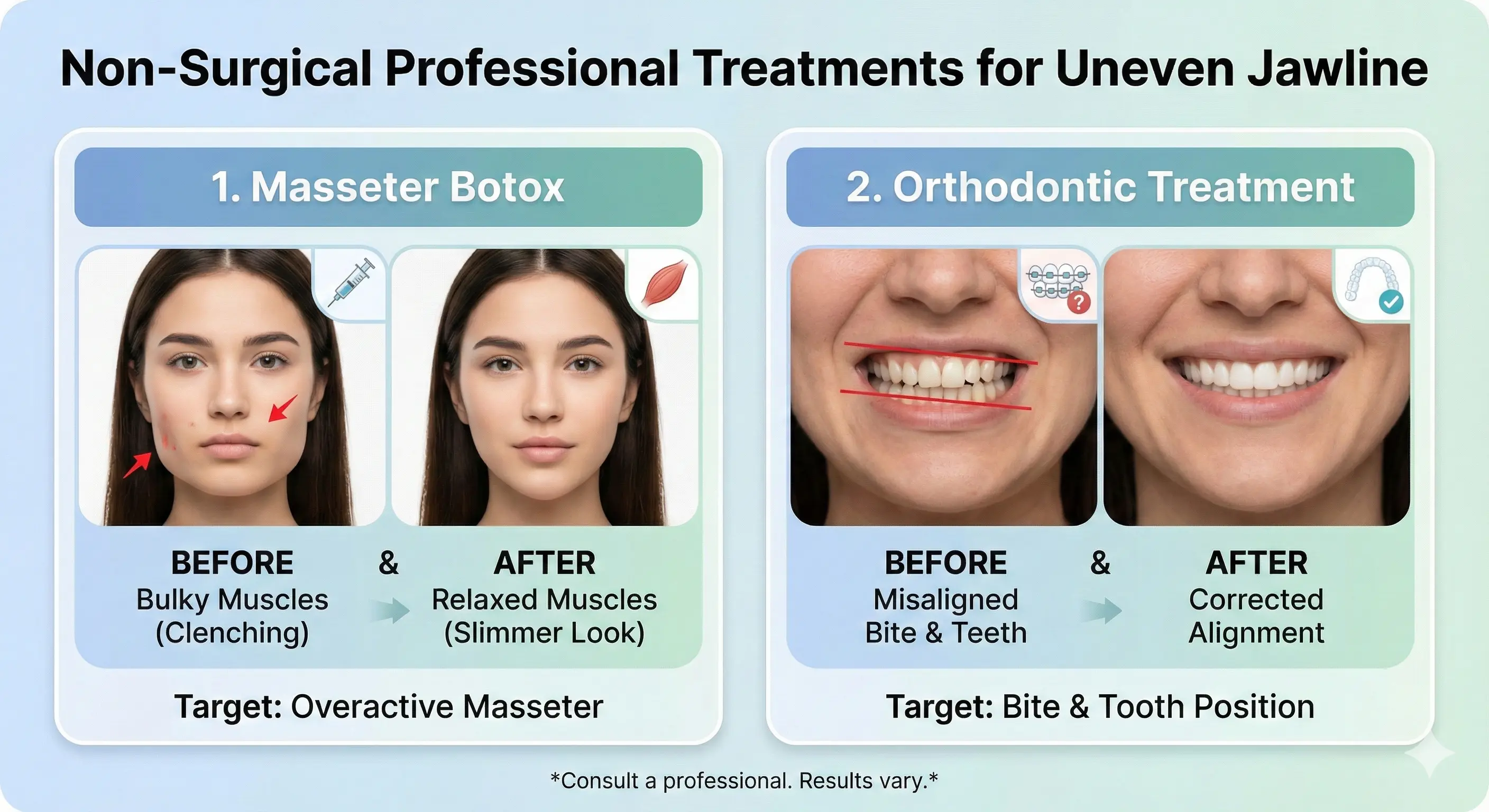 Non-Surgical Professional Treatments
These are for moderate asymmetry or when self-correction isn't enough.
Non-Surgical Professional Treatments
These are for moderate asymmetry or when self-correction isn't enough.
5. Masseter Botox
If your uneven jawline is caused by one masseter muscle being larger than the other, Botox can selectively relax and shrink the overdeveloped side.
How it works:
- Botox is injected into the larger masseter
- The muscle gradually weakens and shrinks over 4-8 weeks
- Creates better balance between both sides
Best candidates:
- People whose asymmetry is clearly muscle-based
- Those who clench or grind their teeth
- Anyone wanting faster results than exercises provide
What to expect:
- Cost: $300-$800 per treatment
- Timeline: Results visible in 2-4 weeks, peak at 6-8 weeks
- Duration: Lasts 4-6 months; repeat treatments needed
- Key: Find an experienced provider who can inject asymmetrically — more on the larger side
6. Orthodontic Treatment
If your uneven jawline stems from bite problems, fixing the underlying dental issues can improve jaw positioning.
Options include:
- Braces or clear aligners: Correct bite alignment over 12-24 months
- Dental splints: Address TMJ-related jaw positioning
- Mouthguards: Protect against nighttime grinding that worsens asymmetry
- Missing tooth replacement: Implants or bridges restore proper bite balance
What to expect:
- Cost: $3,000-$8,000 for comprehensive treatment
- Timeline: 12-24 months for full correction
- Bonus: Fixing your bite often improves overall facial balance, not just the jawline
Tier 3: Surgical Options
For severe asymmetry caused by bone structure, surgery may be the most effective solution.
7. Orthognathic Surgery (Jaw Surgery)
This involves surgically repositioning the jaw bones for better alignment.
Types of procedures:
- Maxillary osteotomy: Repositions the upper jaw (corrects overbite or open bite)
- Mandibular osteotomy: Repositions the lower jaw (corrects severe underbite)
- Genioplasty: Reshapes or repositions the chin
Best candidates:
- Significant skeletal asymmetry confirmed by imaging
- Functional problems (difficulty chewing, breathing issues)
- Those who have tried non-surgical options without adequate results
What to expect:
- Cost: $20,000-$50,000+ (may be partially covered by insurance if medically necessary)
- Timeline: Full recovery takes 6-12 months
- Results: Permanent
For a complete overview of all facial asymmetry treatments, see our comprehensive guide to fixing face asymmetry.
Real Results: Emma's 6-Month Progress
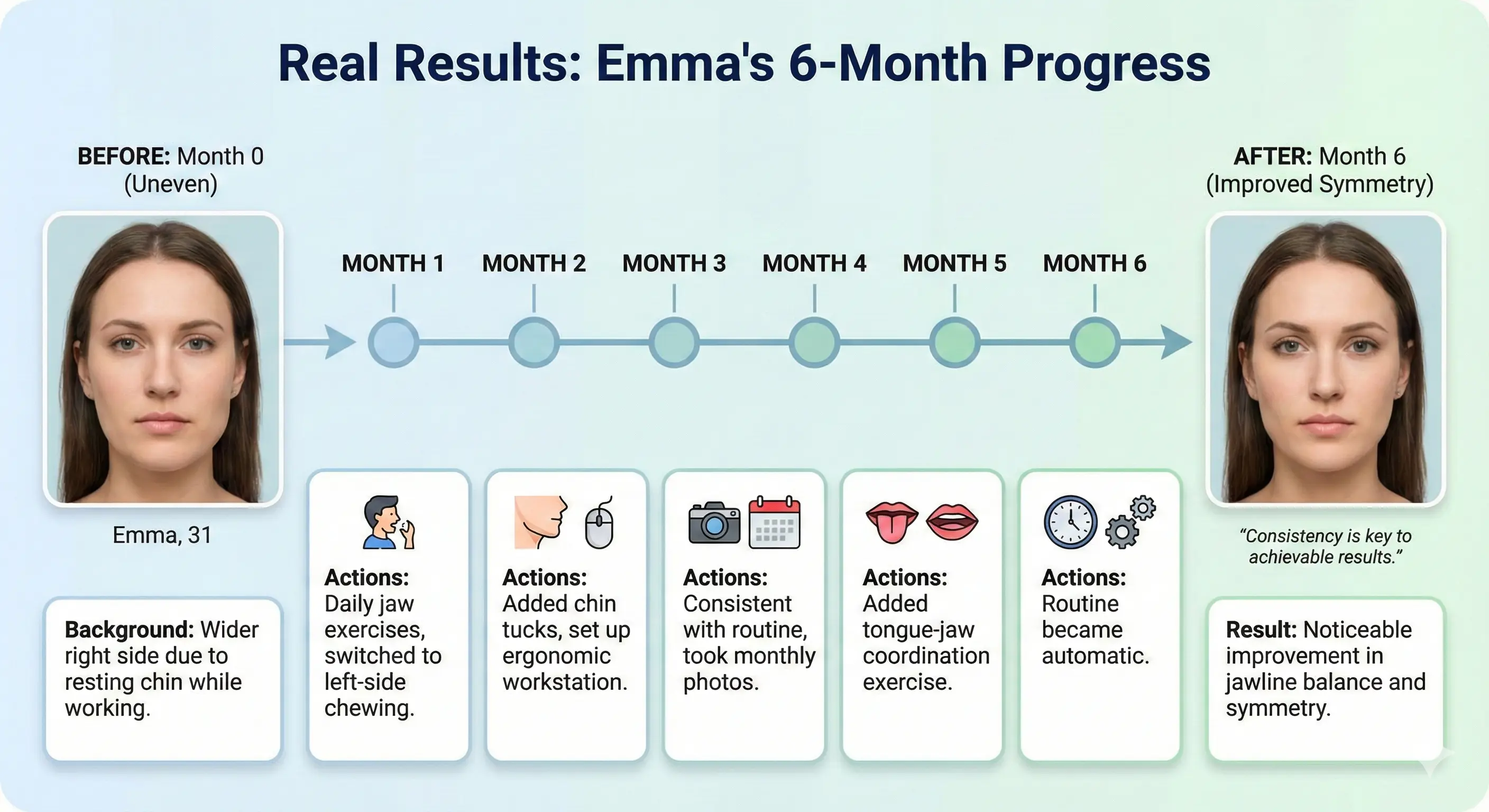 Emma's 6-Month Progress to improve jawline
Let me share a realistic case that shows what's achievable.
Emma's 6-Month Progress to improve jawline
Let me share a realistic case that shows what's achievable.
Background: Emma, 31, noticed her right jawline looked noticeably wider than her left in photos. She'd been a graphic designer for 8 years — spending long hours with her chin resting on her right hand while mousing with her left.
Self-assessment revealed:
- Right masseter significantly tighter and larger when clenched
- Always chewed gum on the right side
- Chronic right-side neck tension
- No TMJ pain or clicking
Her type: Muscle imbalance (masseter hypertrophy) + posture habits
What she did:
| Month | Actions | Observations |
|---|---|---|
| 1 | Started daily jaw exercises, switched to left-side chewing | Jaw felt "weird" but manageable |
| 2 | Added chin tucks, set up ergonomic workstation | Noticed less neck tension |
| 3 | Consistent with routine, took monthly progress photos | Friends said she looked "different" |
| 4 | Added tongue-jaw coordination exercise | Right jaw felt less tight |
| 5 | Routine became automatic | Visible improvement in photos |
| 6 | Retested with Face Symmetry Test | Lower jaw score: 71% → 83% |
Key insight: "I was ready to spend money on Botox, but wanted to try the free options first. The exercises weren't dramatic, but six months of photos side-by-side showed real change. Not perfect — but enough that I stopped obsessing."
What she tracked: Emma used the Face Symmetry Test monthly to measure progress objectively, which kept her motivated during the slow middle months.
3 Mistakes That Make Your Uneven Jawline Worse
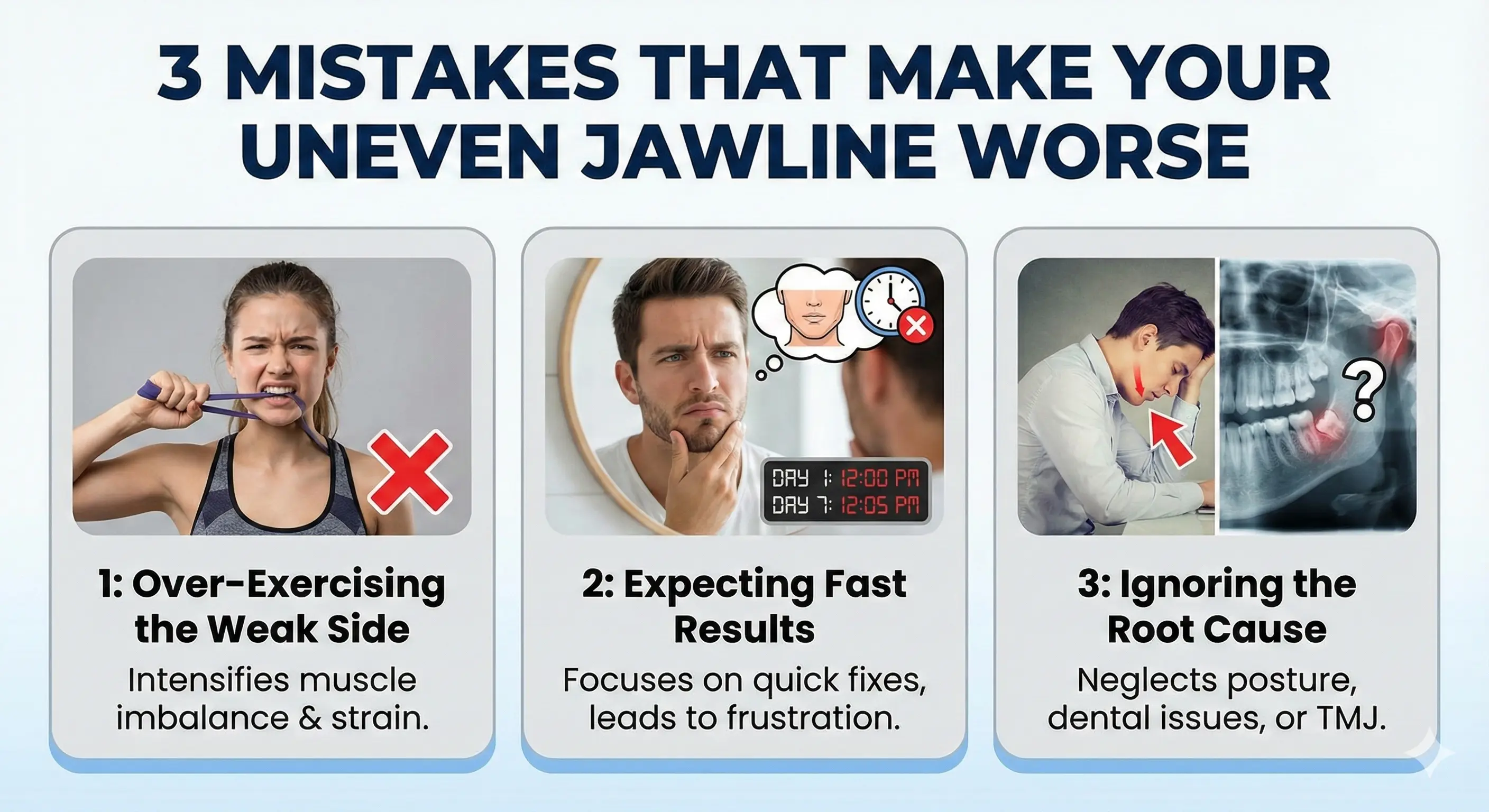 3 Mistakes That Make Your Uneven Jawline Worse
Avoid these common errors:
Mistake #1: Over-Exercising the Weak Side
It's tempting to work the smaller side extra hard to "catch up." But overdoing it can:
- Cause muscle strain or TMJ irritation
- Create NEW imbalances
- Lead to jaw pain
Instead: Do exercises on BOTH sides. You can spend slightly more time on the larger side (releasing tension) rather than overworking the smaller side.
Mistake #2: Expecting Fast Results
Most people give up after 2-3 weeks because they don't see dramatic changes.
Realistic timelines:
- Habit changes: 4-8 weeks for muscle changes
- Exercise results: 6-12 weeks for initial changes
- Full correction: 4-6 months or longer
Instead: Take monthly progress photos from the same angle with the same lighting. Small changes are invisible day-to-day but obvious over months.
Mistake #3: Ignoring the Root Cause
Doing jaw exercises while still:
- Chewing on one side
- Resting your chin on your hand
- Sleeping on the same side every night
...is like mopping the floor while the faucet is still running.
Instead: Identify YOUR primary cause first. Fix the habit, then add exercises as support.
Your 3-Step Action Plan
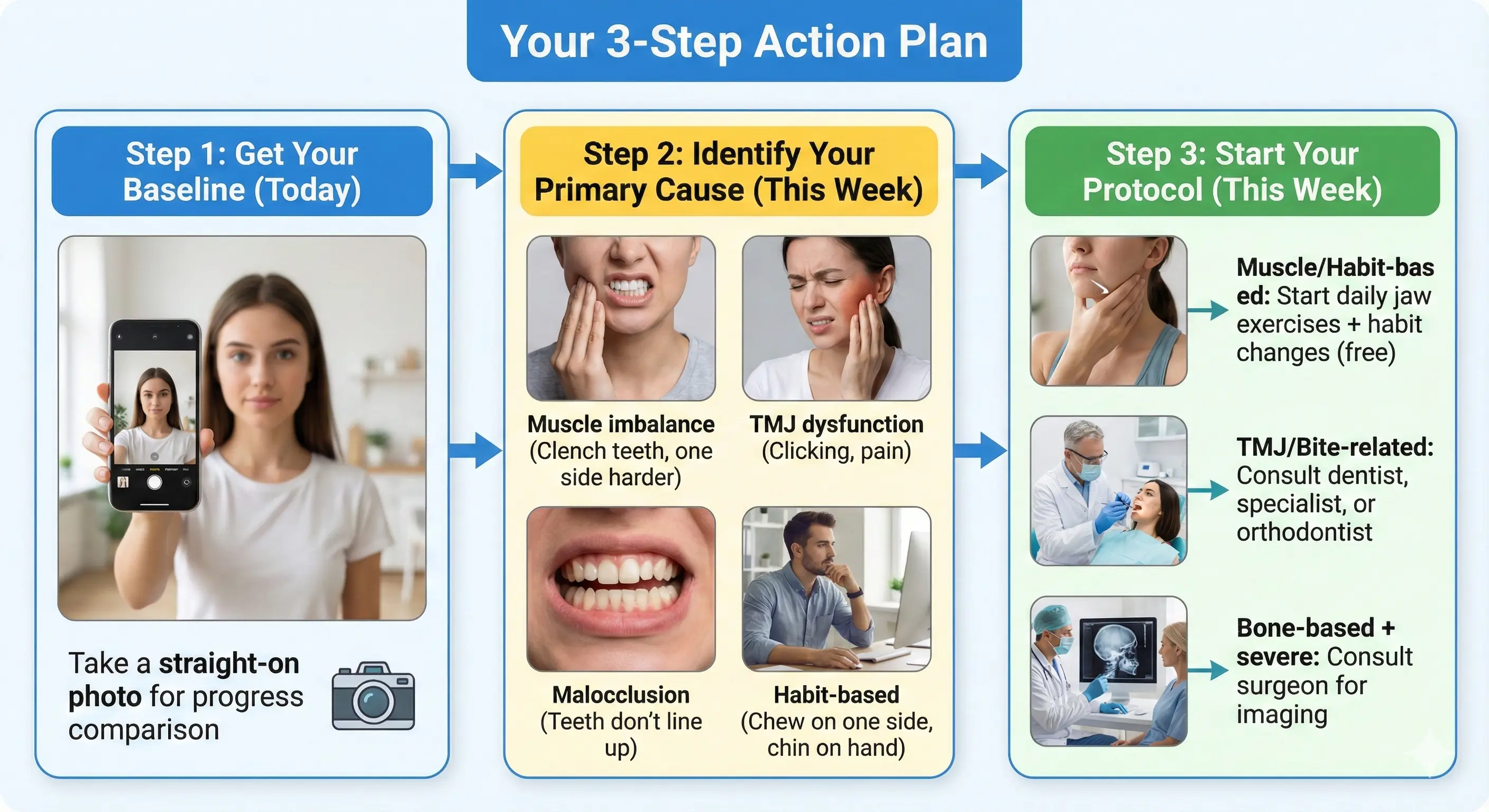 Your 3-Step Action Plan to Improve Jawline
Ready to fix your uneven jawline? Here's exactly what to do:
Step 1: Get Your Baseline (Today)
- Take the Face Symmetry Test to get objective measurements
- Note which areas show the most asymmetry
- Take a straight-on photo for progress comparison
Step 2: Identify Your Primary Cause (This Week)
| Self-Check | What to Look For | Likely Cause |
|---|---|---|
| Clench teeth, feel both sides | One side harder/bigger | Muscle imbalance |
| Open mouth wide | Clicking, popping, pain | TMJ dysfunction |
| Check your bite | Teeth don't line up | Malocclusion |
| Think about habits | Always chew on one side, chin on hand | Habit-based |
| Consider history | Asymmetry since childhood | Bone structure |
Step 3: Start Your Protocol (This Week)
If muscle/habit-based: → Start daily jaw exercises + habit changes (free)
If TMJ-related: → Book appointment with dentist or TMJ specialist first
If bite-related: → Consult orthodontist for evaluation
If bone-based + severe: → Consult maxillofacial surgeon for imaging
Expected Results Timeline
| Approach | First Changes | Significant Improvement |
|---|---|---|
| Exercises + habits | 6-8 weeks | 4-6 months |
| Masseter Botox | 2-4 weeks | 6-8 weeks |
| Orthodontics | 3-6 months | 12-24 months |
| Surgery | After recovery | 6-12 months |
FAQ
Can you fix an uneven jawline naturally?
Yes — if it's caused by muscle imbalance or habits. Studies show that jaw exercises combined with posture correction can improve mild to moderate asymmetry over 3-6 months. Bone-based asymmetry typically requires professional intervention.
How long does it take to see results from jaw exercises?
With consistent daily practice (5-10 minutes, twice daily), most people notice initial changes in 6-8 weeks. Significant improvement typically takes 4-6 months. Progress is gradual, so monthly photos help track changes you might not notice day-to-day.
Is jaw asymmetry permanent?
Not necessarily. Muscle-based asymmetry can often be improved with exercises and habit changes. Even bone-based asymmetry can be addressed with orthodontics or surgery if desired. The goal isn't perfect symmetry (which doesn't exist) but improved balance.
When should I see a doctor about my uneven jaw?
See a professional if you have:
- Jaw pain, clicking, or locking
- Difficulty chewing or opening your mouth
- Headaches related to jaw tension
- Rapid or recent changes in jaw appearance
- Asymmetry that significantly affects function
Final Thoughts
Here's what I want you to remember:
Perfect symmetry doesn't exist. Even models and celebrities have asymmetrical faces. The goal isn't perfection — it's improvement and confidence.
Most uneven jawlines are fixable without surgery. If yours is caused by muscle imbalance or habits (and most are), consistent effort over several months can make a real, visible difference.
Start with understanding, not treatment. Knowing what's causing YOUR asymmetry helps you choose the right approach and avoid wasting time on solutions that won't work for you.
Your jawline doesn't define you. But if improving it would boost your confidence, you now have a clear roadmap to make it happen.
Ready to start?
Get your baseline measurements and see exactly where your asymmetry is — so you can track real progress over time.