
Why Is My Nose Crooked? Causes, Fixes, and What Actually Works
Why Is My Nose Crooked? Causes, Fixes, and What Actually Works
 Look in the mirror. Does your nose seem to veer slightly to one side? Or maybe it looks straight in the mirror but crooked in every photo? You're not imagining it—and you're definitely not alone.
Here's what most people don't realize: almost no one has a perfectly straight nose. Studies show that about 80% of people have some degree of nasal deviation. Perfect symmetry is actually the exception, not the rule.
But understanding why your nose looks crooked—and whether it's something you should address—can save you a lot of unnecessary worry. Some causes are purely cosmetic. Others might affect your breathing. And that "crooked" appearance in photos? It might not even be real.
Let's break down everything you need to know about crooked noses, from what causes them to what actually works to fix them.
Is a Crooked Nose Normal?
Yes, a slightly crooked nose is completely normal. In fact, it's the default state for most humans.
Your nose is made up of bone (the upper third) and cartilage (the lower two-thirds). These structures develop over time and are influenced by genetics, injuries, and even how you sleep. Perfect alignment of all these parts is rare.
Here's a quick way to check your nose alignment at home:
The Mirror Self-Test:
- Stand in front of a mirror in good lighting
- Look straight ahead with a relaxed face
- Imagine a vertical line from the center of your forehead, down through the middle of your nose, to your chin
- Does your nose follow this line, or does it curve away?
If there's a slight deviation, that's normal. Most people have asymmetrical features—including their nose. The question isn't whether your nose is perfectly straight (it probably isn't), but whether the asymmetry bothers you or affects your daily life.
When asymmetry becomes a concern:
- Breathing feels blocked on one side
- You frequently get sinus infections
- You snore heavily or have sleep issues
- The crookedness is getting worse over time
- It significantly impacts your self-confidence
If none of these apply, your crooked nose is likely just a normal variation of human anatomy.
Want to see how your nose fits into your overall facial balance? Try free Face Symmetry Test to analyze your facial proportions and understand how all your features work together.
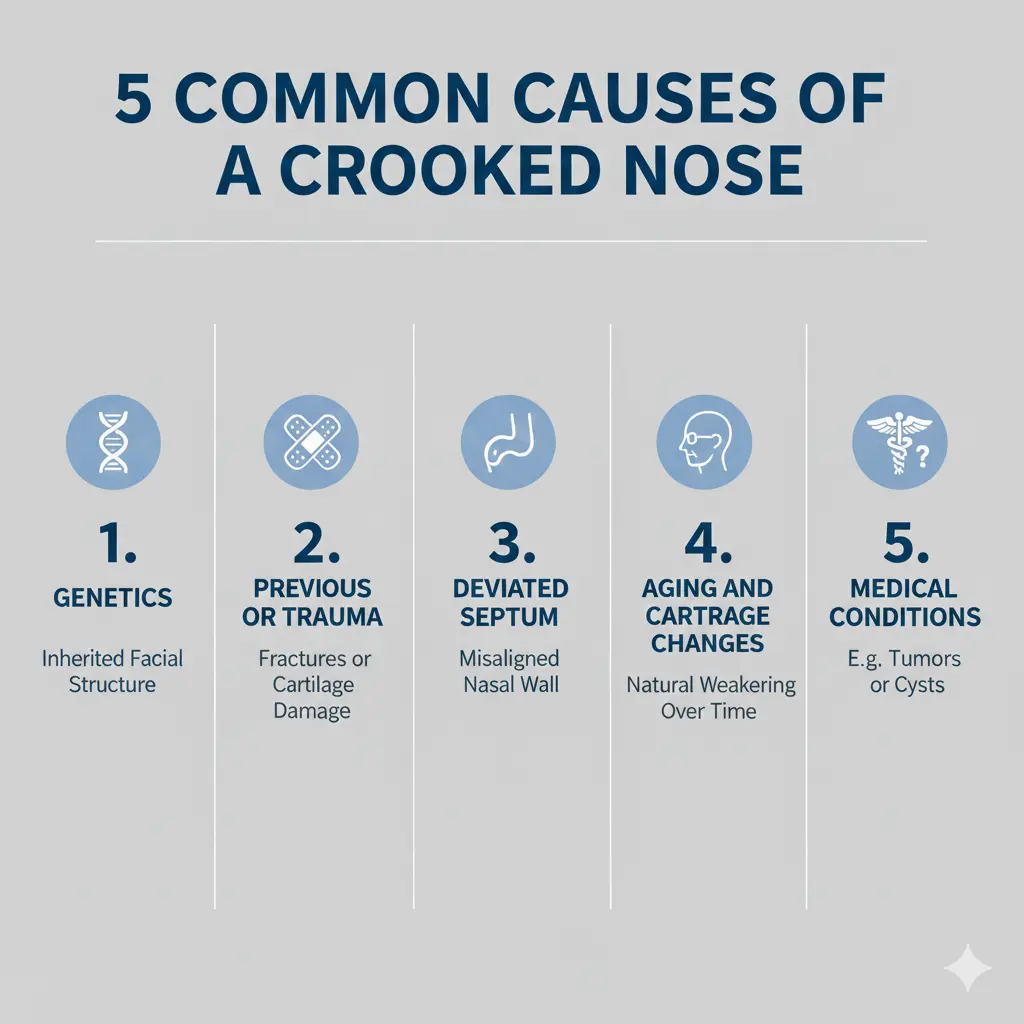
5 Common Causes of a Crooked Nose
 5 Common Causes of a Crooked Nose
Understanding what caused your nose to look crooked can help you figure out the best solution—or whether you even need one.
5 Common Causes of a Crooked Nose
Understanding what caused your nose to look crooked can help you figure out the best solution—or whether you even need one.
1. Genetics (You Were Born With It)
The most common reason for a crooked nose? You inherited it.
Just like the shape of your eyes or the curve of your jaw, nose shape is largely determined by your genes. If your parents or grandparents have asymmetrical noses, there's a good chance you will too.
Genetic factors affect:
- The overall size and shape of your nose
- How the cartilage and bone develop
- The angle of your nasal bridge
- The position of your nostrils
What you can do: If you were born with a crooked nose and it doesn't affect your breathing, this is simply your unique facial structure. Cosmetic options exist if it bothers you, but there's nothing medically wrong.
2. Previous Injury or Trauma
Ever taken a ball to the face during sports? Or bumped your nose hard as a kid? Even minor injuries can shift the cartilage or bone, leading to a crooked appearance later.
Common nose injuries include:
- Sports accidents (basketball, soccer, martial arts)
- Car accidents
- Falls during childhood
- Accidental impacts (doors, elbows, pets)
Here's the thing: you might not even remember the injury. Childhood impacts that seemed minor can affect how your nose develops over the years. A crooked nose in adulthood might be traced back to that time you fell off the jungle gym at age 5.
Signs your crooked nose might be from injury:
- Asymmetry appeared or worsened after a specific incident
- One side of your nose feels different to touch
- You have occasional pain or tenderness
- There's visible scarring or unevenness on the skin
What you can do: Old injuries can sometimes be corrected with rhinoplasty. If the injury is recent (within 2 weeks), see a doctor immediately—early intervention can prevent permanent changes.
3. Deviated Septum
The septum is the wall of cartilage and bone that divides your nasal cavity into two sides. When it's significantly off-center, it's called a deviated septum—and it's extremely common. About 80% of people have some degree of septal deviation.
A deviated septum can make your nose appear crooked from the outside, but its main impact is on breathing. One nostril gets less airflow than the other.
Symptoms of deviated septum:
- One nostril always feels more blocked
- Frequent nosebleeds
- Recurring sinus infections
- Loud breathing or snoring
- Preference for sleeping on one side
- Facial pain or headaches
Important distinction: A deviated septum is an internal structural issue. A crooked nose appearance is external. You can have one without the other, or both together. We'll dive deeper into this difference in the next section.
What you can do: If breathing is affected, see an ENT (ear, nose, throat) specialist. Surgery called septoplasty can correct internal deviation and improve breathing—though it won't necessarily change how your nose looks from the outside.
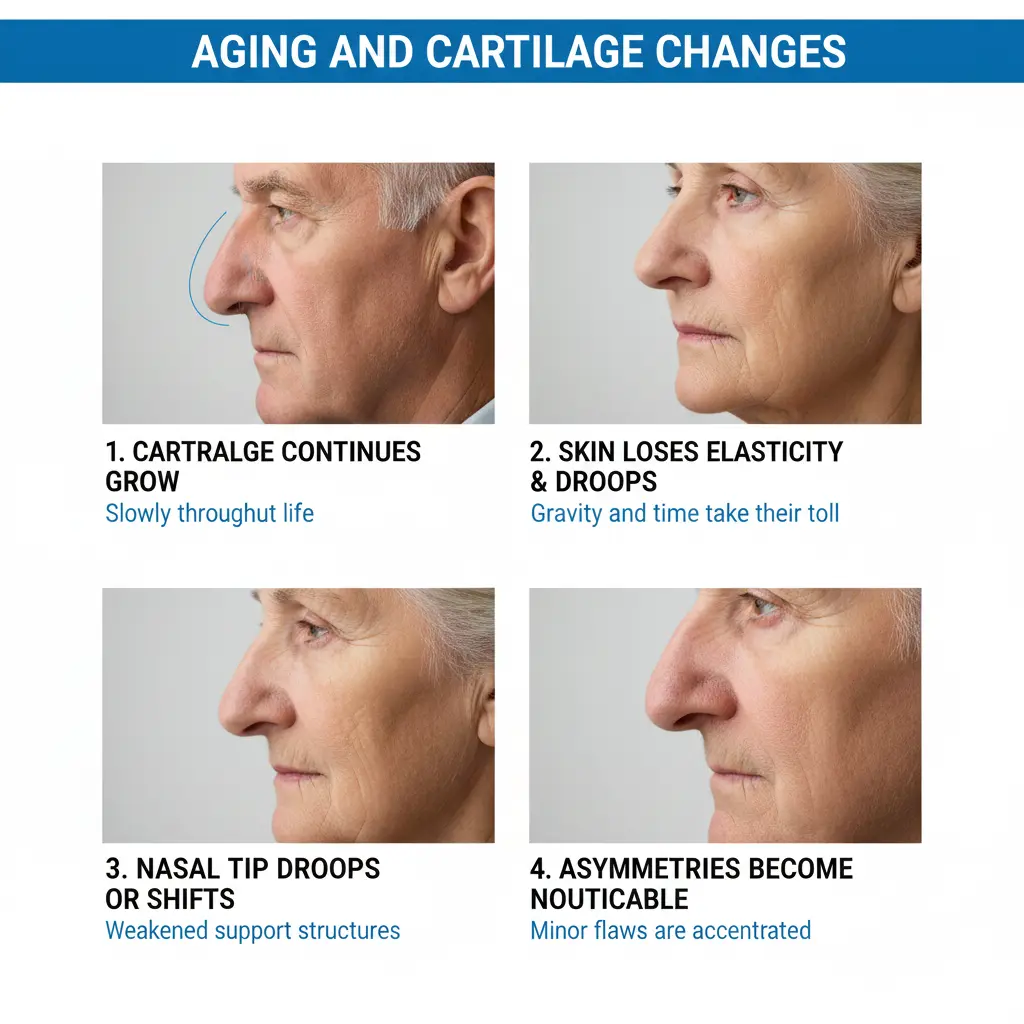
4. Aging and Cartilage Changes
 Aging and Cartilage Changes to a Crooked Nose
Your nose doesn't stop changing when you finish growing. As you age, several things happen:
Aging and Cartilage Changes to a Crooked Nose
Your nose doesn't stop changing when you finish growing. As you age, several things happen:
- Cartilage continues to grow (slowly) throughout life
- Skin loses elasticity and droops
- The tip of your nose may droop or shift
- Previous minor asymmetries become more noticeable
This is why some people notice their nose looking more crooked in their 40s, 50s, or beyond—even though it seemed straight when they were younger.
What you can do: Aging changes are gradual and natural. If it bothers you, non-surgical options like fillers can sometimes camouflage minor changes. Rhinoplasty is an option for more significant concerns.
5. Medical Conditions
Less commonly, certain medical conditions can cause or worsen nasal asymmetry:
- Tumors or growths: Benign growths in the nasal cavity can push the septum to one side
- Severe infections: Untreated infections can damage cartilage
- Inflammatory conditions: Certain autoimmune conditions affect nasal cartilage
- Previous surgery: Prior nasal surgery can sometimes result in asymmetry
Warning signs to see a doctor:
- Sudden change in nose shape without injury
- Severe or worsening breathing problems
- Pain that doesn't go away
- Nosebleeds that are frequent or heavy
- Changes accompanied by other symptoms (fever, swelling, vision changes)
If any of these apply, don't try to self-diagnose. See a healthcare provider.
Crooked Nose vs. Deviated Septum: What's the Difference?
These terms are often confused, but they're not the same thing. Understanding the difference helps you know what kind of solution you might need.
| Feature | Crooked Nose | Deviated Septum |
|---|---|---|
| What it is | External appearance—nose looks bent or off-center | Internal structure—septum (wall between nostrils) is off-center |
| Visibility | Visible from outside | Usually not visible from outside |
| Main concern | Cosmetic appearance | Breathing and sinus issues |
| Treatment | Rhinoplasty (cosmetic) | Septoplasty (functional) |
| Who treats it | Plastic surgeon or facial plastic surgeon | ENT specialist or plastic surgeon |
You can have:
- A crooked nose WITHOUT a deviated septum (purely cosmetic concern)
- A deviated septum WITHOUT a crooked nose (breathing issues, nose looks straight)
- Both together (breathing problems AND crooked appearance)
How to tell what you have:
Crooked nose signs:
- Visible crookedness when looking in the mirror
- Nose appears to curve or lean to one side
- Bridge or tip is noticeably off-center
Deviated septum signs:
- One nostril consistently harder to breathe through
- Frequent sinus infections or congestion
- Snoring or sleep issues
- Nosebleeds
If you have both cosmetic and breathing concerns, you might be a candidate for septorhinoplasty—a combined procedure that addresses both the internal structure and external appearance.
Why Your Nose Looks More Crooked in Photos (The 2x Distortion Effect)
 Why Your Nose Looks More Crooked in Photos
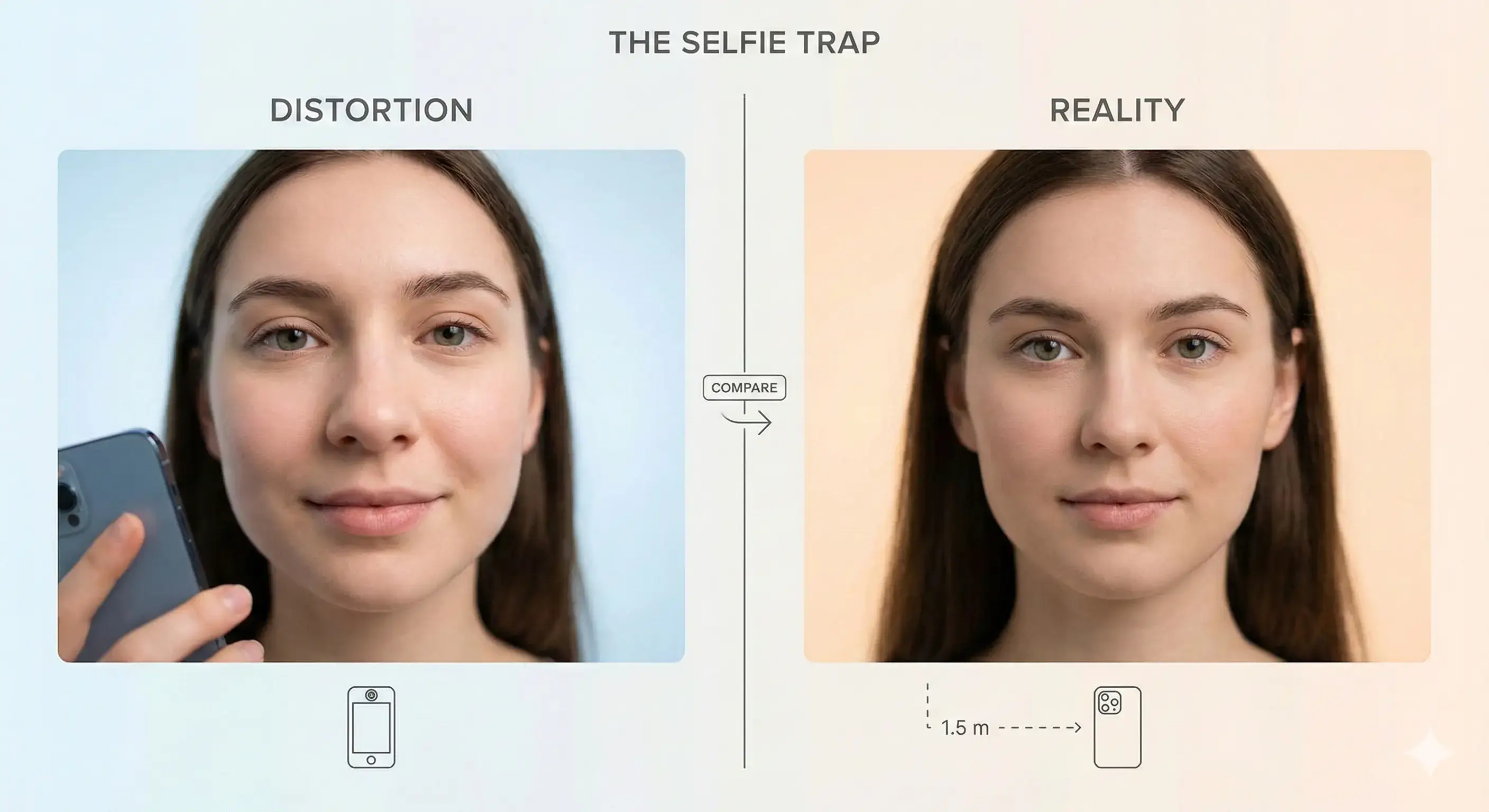
Here's something that might change how you feel about your nose: the crooked nose you see in photos probably isn't what others see in real life.
Phone cameras distort facial features. The lens creates a "barrel distortion" effect that exaggerates anything close to the camera—and since your nose is the closest thing to the lens when taking a selfie, it gets the most distortion.
But there's an even more interesting phenomenon at play.
The 2x Distortion Effect:
When you see yourself in the mirror, you're seeing a flipped image—and you're used to it. Your brain has adjusted to this reversed version of your face.
When you see a photo (which shows the non-flipped version that others actually see), any asymmetry appears doubled. It's not just that you're seeing the real asymmetry—you're seeing the difference between what you expected (mirror image) and what's actually there. This creates a psychological "2x distortion" effect.
As one Reddit user explained:
You expect one side to look a certain way because that's what you're used to in the mirror. When it's flipped, not only is it not what you expected, but it's the opposite. That's why asymmetry looks twice as bad in photos.
Why photos make your nose look worse:
- Lens distortion: Wide-angle phone cameras enlarge close objects
- Distance: Selfies are taken too close, maximizing distortion
- Mirror flip: You're seeing the unfamiliar non-mirrored version
- Lighting: Phone flash creates harsh shadows that emphasize asymmetry
- Angle: Slight tilts exaggerate crookedness
How to take more flattering photos:
- Hold the camera at arm's length or use a timer
- Use the back camera instead of the selfie camera
- Face soft, even lighting (near a window)
- Keep your face level with the camera
- Use portrait mode if available (it reduces distortion)
For a deeper dive into why mirrors and cameras show your face differently, check out our guide on whether the mirror or camera is more accurate.
How to Fix a Crooked Nose: All Your Options
Depending on the severity of your crooked nose and whether it affects your breathing, you have several options—from simple daily tricks to surgical correction.
Non-Surgical Solutions
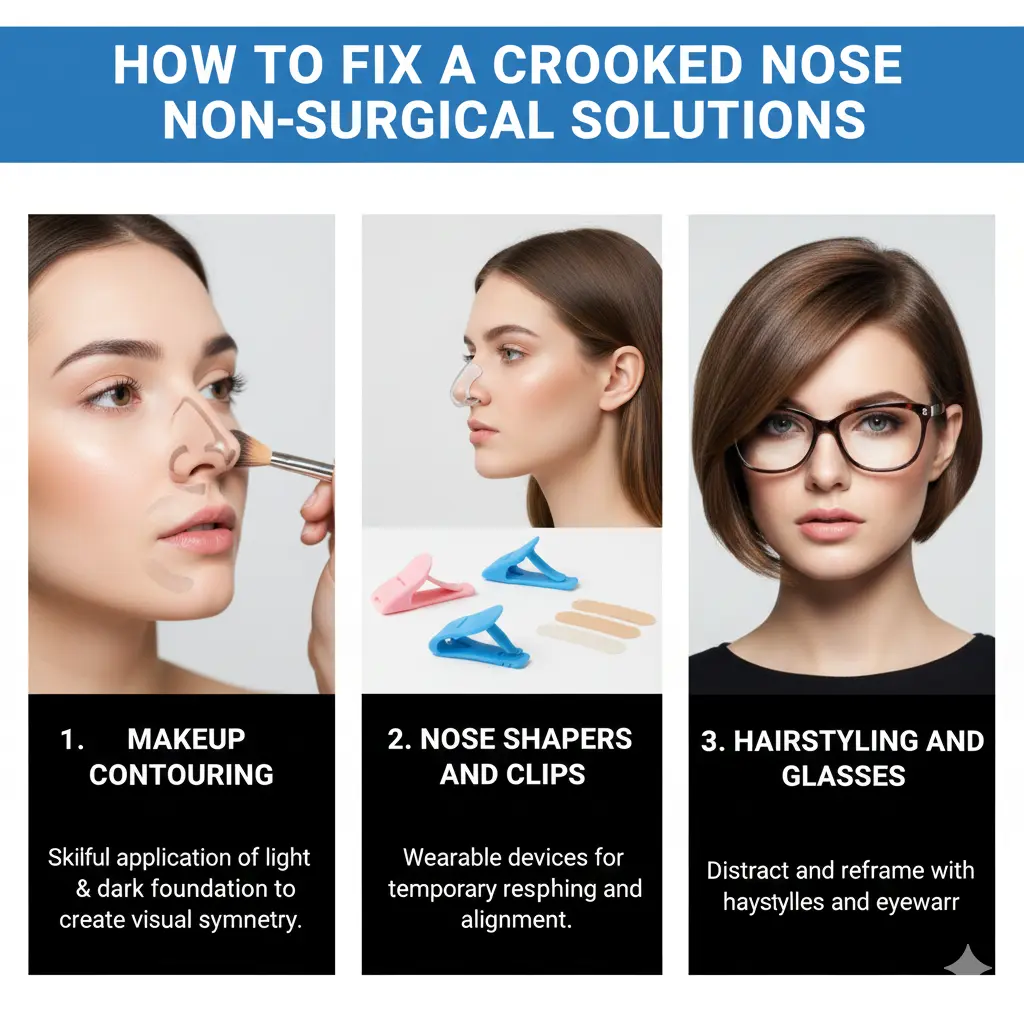 How to Fix a Crooked Nose with Non-Surgical Solutions
1. Makeup Contouring
How to Fix a Crooked Nose with Non-Surgical Solutions
1. Makeup Contouring
Strategic makeup can create the illusion of a straighter nose. This technique uses light and shadow to visually correct asymmetry.
Step-by-step nose contouring:
- Apply foundation to create an even base
- Draw straight contour lines: Using a shade 2-3 tones darker than your skin, draw a straight line down each side of your nose. The key is to draw the lines where you WANT the sides to be—not where they actually are
- Highlight the center: Apply a light shade (or highlighter) down the center of your nose in a perfectly straight line
- Blend carefully: Use a small brush or sponge to blend the contour outward and the highlight gently
- Set with powder to keep it in place
You can also refer to advice shared by a Reddit user:
Detailed instructions:
- Cover your nose with foundation if it has an uneven tone to it.
- Apply concealer that's lighter than your skin tone on the part of your nose that bends in and cool toned eyeshadow on the part that's going out. I also put the eyeshadow next to the tip of my nose and under but that might have a different effect on your nose shape and is therefore optional.
- Blend it out. The three other steps are pretty much optional.
- Put concealer next to your nose bridge to slim it down and blend it out.
- I put some blush or lipstick under my nose and blend it out because i think it looks cute.
- Add a little bit of highlighter or shimmer shadow to the tip of your nose. Too much can look a bit funny. - r/MakeupAddiction
Pro tips:
- Use cream products for a natural look, powder for longer wear
- Keep contour lines thin—thick lines look obvious
- The bridge should be highlighted in a straight vertical line regardless of actual nose shape
- Blend well at the edges to avoid harsh lines
2. Nose Shapers and Clips
You've probably seen these advertised online—silicone clips that claim to reshape your nose over time. Here's the truth:
- Do they work? There's no scientific evidence that nose shapers permanently change cartilage structure in adults
- Are they safe? Generally safe if used gently, but can cause skin irritation or pressure marks
- Temporary effect? Some users report their nose looks slightly different immediately after removing the clip, but this is temporary swelling/compression
Verdict: Don't expect permanent results, but if you enjoy using them, they're unlikely to cause harm with gentle use.
3. Strategic Hairstyling and Glasses
Sometimes the best solution is distraction. Certain hairstyles and accessories draw attention away from the nose:
- Side-swept bangs can balance facial asymmetry
- Frames with detail at the temples draw eyes outward
- Thick-rimmed glasses create visual interest that minimizes nose focus
- Avoid: Thin, round glasses that sit on the nose bridge and emphasize its shape
Non-Surgical Medical Treatments
Dermal Fillers (Liquid Rhinoplasty)
Injectable fillers can camouflage a crooked nose by adding volume strategically:
- How it works: Hyaluronic acid filler is injected to fill in dips, straighten the bridge, or balance asymmetry
- Best for: Minor crookedness, bumps, or dips; tip adjustments
- Not for: Reducing size, fixing breathing issues, or correcting severe deviation
- Duration: 12-18 months
- Cost: $600-$1,500 per session
- Recovery: Minimal—some swelling for a few days
Pros:
- No surgery or downtime
- Reversible (filler can be dissolved)
- See results immediately
- Much cheaper than surgery
Cons:
- Temporary—requires maintenance
- Can only add volume, not remove
- Won't fix breathing problems
- Risk of complications if done incorrectly (choose an experienced injector)
Surgical Options
 How to Fix a Crooked Nose with Non-Surgical Solutions
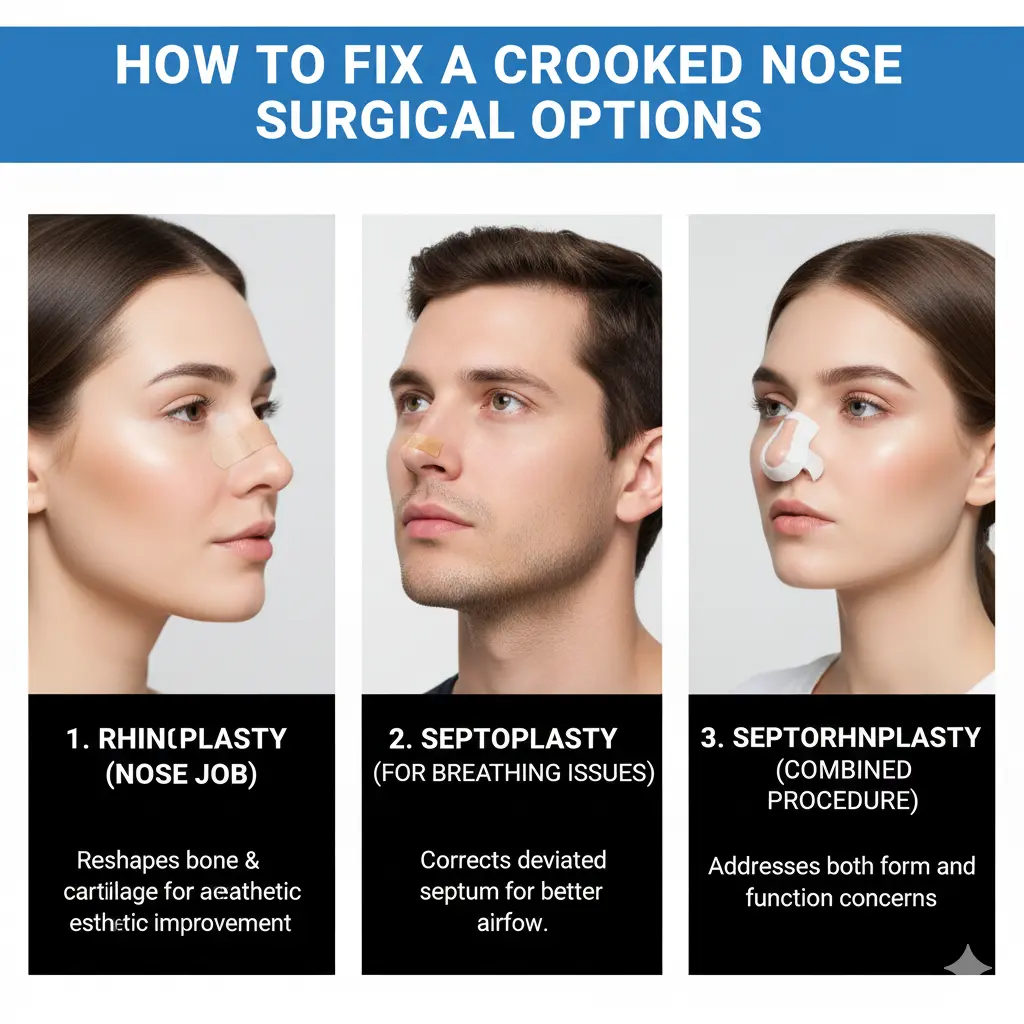
Rhinoplasty (Nose Job)
How to Fix a Crooked Nose with Non-Surgical Solutions
Rhinoplasty (Nose Job)
For permanent correction of a crooked nose appearance, rhinoplasty is the gold standard.
- What it does: Reshapes bone and cartilage to straighten the nose
- Best for: Significant crookedness, bumps, asymmetry; cosmetic concerns
- Cost: $5,000-$15,000 (varies by location and surgeon)
- Recovery: 1-2 weeks of bruising/swelling; full results visible at 1 year
- Results: Permanent
What to expect:
- Consultation to discuss goals and assess anatomy
- Surgery under general or local anesthesia (1-3 hours)
- Cast or splint worn for about a week
- Bruising around eyes for 1-2 weeks
- Swelling gradually decreases over months
- Final results visible at 12-18 months
Septoplasty (For Breathing Issues)
If your crooked nose is accompanied by breathing problems due to a deviated septum:
- What it does: Straightens the septum internally to improve airflow
- Best for: Deviated septum causing breathing difficulty
- Does NOT change: External appearance of nose
- Cost: $3,000-$10,000; often covered by insurance if medically necessary
- Recovery: 1-2 weeks
Septorhinoplasty (Combined Procedure)
When you have both functional (breathing) and cosmetic concerns:
- What it does: Corrects deviated septum AND reshapes external nose
- Best for: Patients with both breathing problems and crooked appearance
- Cost: $6,000-$15,000
- Recovery: Similar to rhinoplasty
Choosing a surgeon:
- Look for board-certified plastic surgeons or facial plastic surgeons
- Check before/after photos of crooked nose corrections specifically
- Read reviews and ask about complication rates
- Don't choose based on price alone—this is your face
When to See a Doctor
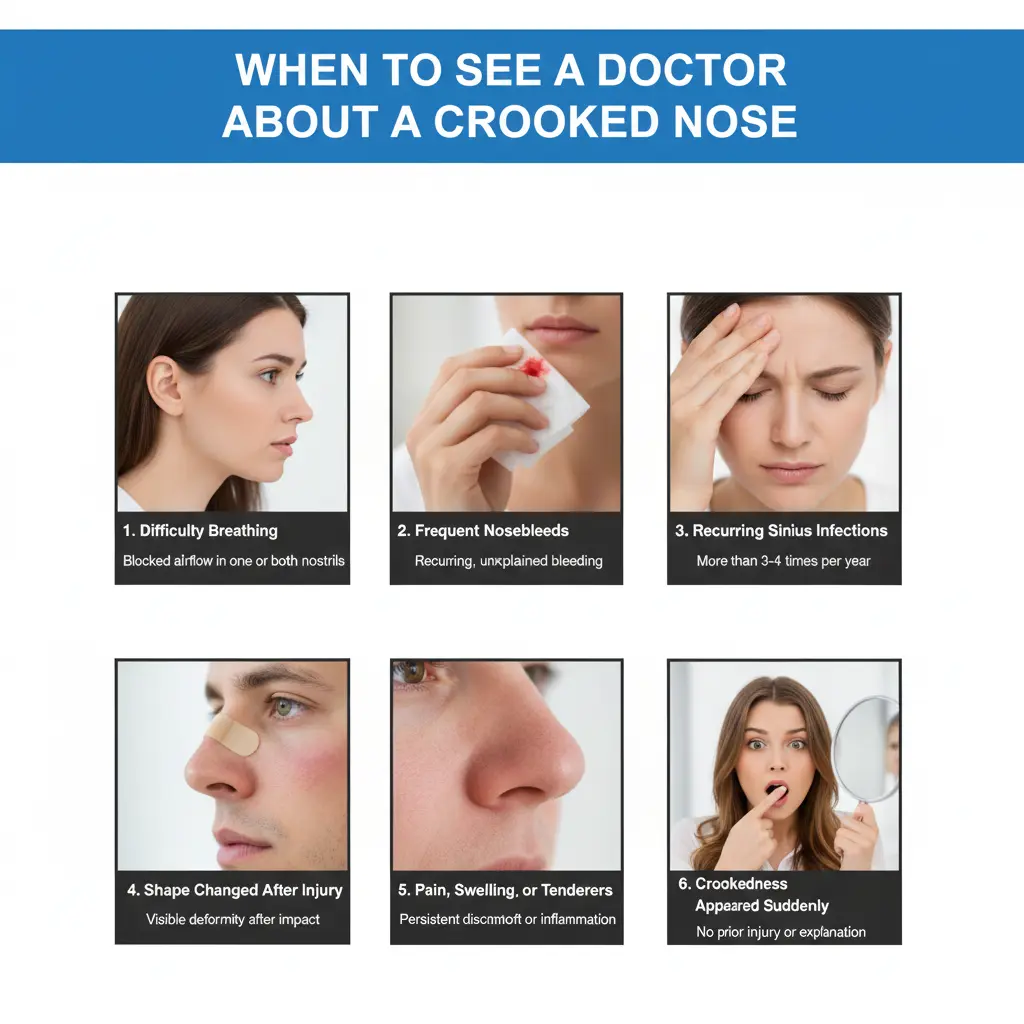 When to See a Doctor About a Crooked Nose
Most crooked noses are purely cosmetic and don't require medical attention. However, you should see a doctor if:
When to See a Doctor About a Crooked Nose
Most crooked noses are purely cosmetic and don't require medical attention. However, you should see a doctor if:
See a Doctor Promptly If:
- ⚠️ You have difficulty breathing through one or both nostrils
- ⚠️ You experience frequent nosebleeds
- ⚠️ You get recurring sinus infections (more than 3-4 per year)
- ⚠️ Your nose changed shape after an injury
- ⚠️ You have pain, swelling, or tenderness that won't go away
- ⚠️ The crookedness appeared suddenly without injury
See a Doctor If It Affects Quality of Life:
- Chronic snoring or sleep apnea
- Headaches or facial pressure
- Significant impact on self-confidence
- Difficulty with physical activities due to breathing
Which Doctor to See:
- ENT (Otolaryngologist): For breathing issues, deviated septum, or sinus problems
- Plastic Surgeon / Facial Plastic Surgeon: For cosmetic concerns
- Primary Care Doctor: Good starting point—they can refer you to the right specialist
Frequently Asked Questions
Can you fix a crooked nose naturally without surgery?
There's no proven natural method to permanently straighten a crooked nose. Exercises, nose clips, and massage won't change bone or cartilage structure in adults. However, makeup contouring can create the illusion of a straighter nose, and fillers offer a temporary non-surgical option.
Does sleeping on one side make your nose crooked?
Not really. While sleeping position can affect facial skin and puffiness, it doesn't have enough force to change bone or cartilage structure. Your nose shape is determined by genetics and any injuries, not by sleeping habits.
How much does it cost to fix a crooked nose?
Costs vary widely:
- Makeup: $20-$50 for products
- Dermal fillers: $600-$1,500 per session (temporary)
- Rhinoplasty: $5,000-$15,000 (permanent)
- Septoplasty: $3,000-$10,000 (may be covered by insurance)
Can a crooked nose get worse over time?
Yes, it can. Cartilage continues to change throughout life, and previous injuries can lead to progressive changes. Aging also affects skin elasticity, which can make existing asymmetry more noticeable.
Is a crooked nose linked to other facial asymmetry?
Often, yes. Facial asymmetry tends to affect multiple features. If your nose is crooked, you might also notice one side of your face looks different or your jawline is uneven. This is all part of normal human variation.
📖 This article is part of our Complete Guide to Face Symmetry
The Bottom Line
A crooked nose is one of the most common facial features—about 80% of people have some degree of nasal deviation. In most cases, it's completely normal and doesn't require any treatment.
Key takeaways:
- Most crooked noses are genetic and perfectly healthy
- Photos exaggerate crookedness due to lens distortion and the mirror-flip effect
- A deviated septum is different from a crooked nose appearance—one affects breathing, the other is cosmetic
- Non-surgical options exist including makeup contouring and dermal fillers
- Surgery (rhinoplasty) is effective but should be considered carefully
- See a doctor if you have breathing problems, pain, or sudden changes
Your nose doesn't have to be perfectly straight to be perfectly fine. The features that make your face unique are what make it recognizable and human.
Curious about your overall facial symmetry? Take our Face Symmetry Test to see how all your facial features work together—and learn why perfect symmetry isn't the goal.
Want to learn more about facial asymmetry and what you can do about it? Check out our comprehensive guide on how to fix facial asymmetry for more tips and treatment options.